
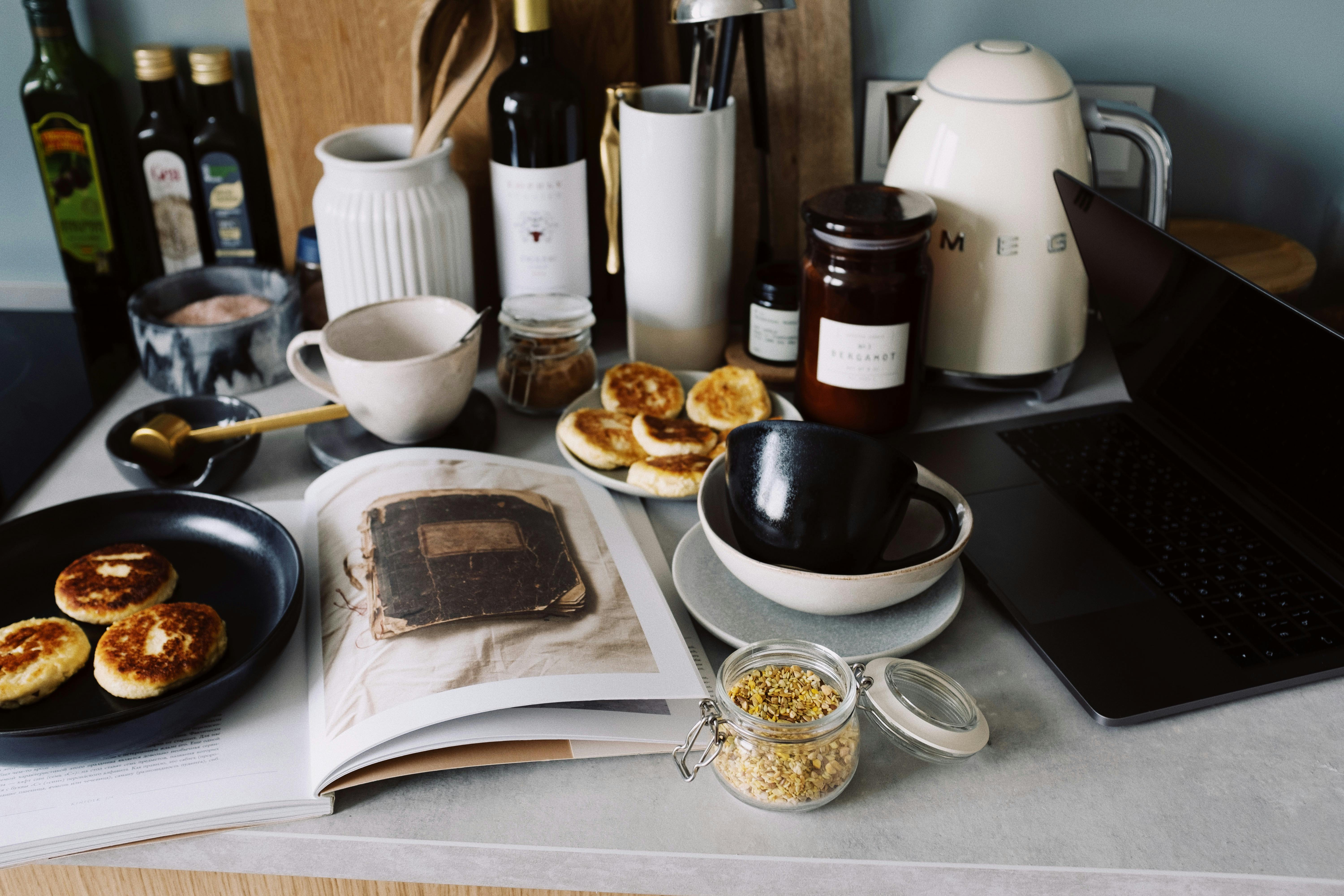
Doubling a recipe looks like arithmetic and behaves like a different recipe. The ingredients scale in a straight line while almost everything the cooking depends on does not.
Surface area does not double with volume
Doubling the contents of a pan roughly doubles the volume but increases the exposed surface far less, since the depth grows while the diameter stays the same.
Heat enters through the base and sides, so each portion of food now receives proportionally less of it and takes longer to reach temperature.
The same geometry means liquid evaporates more slowly, which is why a doubled sauce ends up thinner and needs considerably more time to reduce than twice the original.
Browning stalls in a crowded pan
Food releases water as it heats, and that water has to leave as vapour before the surface can rise to browning temperature.
Twice the food in the same pan releases twice the water into a space that can only carry it away at the same rate as before, so the contents steam instead.
Cooking in two batches solves this properly, whereas turning the heat up merely scorches the material touching the base while the rest continues to stew.
Seasoning and raising agents do not scale straight
Salt and acid are perceived against the whole dish and generally do scale, but strong aromatics such as chilli, garlic and bitter spices often taste stronger when doubled.
Raising agents scale worst of all, because the extra gas they produce has to be supported by a batter structure that has not become proportionally stronger.
A doubled cake batter in one large tin also takes far longer for heat to reach the middle, so the edges overcook before the centre sets.
Timing changes in both directions
Larger volumes take longer to come up to temperature and longer to cool afterwards, which extends every stage of the method.
They also retain heat after the flame is turned off, so a dish that was removed at the right moment in a small pan continues cooking noticeably in a large one.
Judging by state rather than by the clock becomes essential, since none of the original timings remain valid at the new scale.
Some steps should not be scaled at all
Frying, searing and anything that depends on a hot surface should be done in the original quantity repeatedly rather than all at once.
Emulsions and delicate mixtures are also better made in original-sized batches, since a larger mass is harder to keep at an even temperature while working it.
The reliable approach is to scale the ingredients, keep the equipment proportional, and treat the written timings as having been discarded entirely.